

One of the most important decisions when shopping for office furniture is whether to go for a C-frame or a T-frame standing desk.
The frame supports the whole of your desktop. It determines the stability of your monitor during typing. It also determines the amount of knee space you will have when sitting for extended periods of time.
A C-frame standing desk is designed with legs positioned towards the rear. A T-frame standing desk is a desk with legs positioned below the center of the desk. Both are modern styles.
Both have electric height adjustment. But the minor tweak in the overall design has a huge impact on everyday comfort.
Let’s clear up the confusion between the C-frame and T-frame standing desk.
Key Takeaways
- C-frame desks have legs positioned toward the back, offering more legroom and a modern look, while T-frame desks have centered legs for better stability.
- T-frame standing desks are more stable, especially for heavy equipment like dual monitors or wide desktops over 1600mm.
- C-frame desks save space and work well in small rooms or tight corners since they can sit closer to walls.
- T-frame desks last longer and handle daily use better without developing wobble over time.
- The Sendi Standing Desk Frame A is recommended as a reliable T-frame option with dual motors, memory presets, and 1250N lifting capacity.
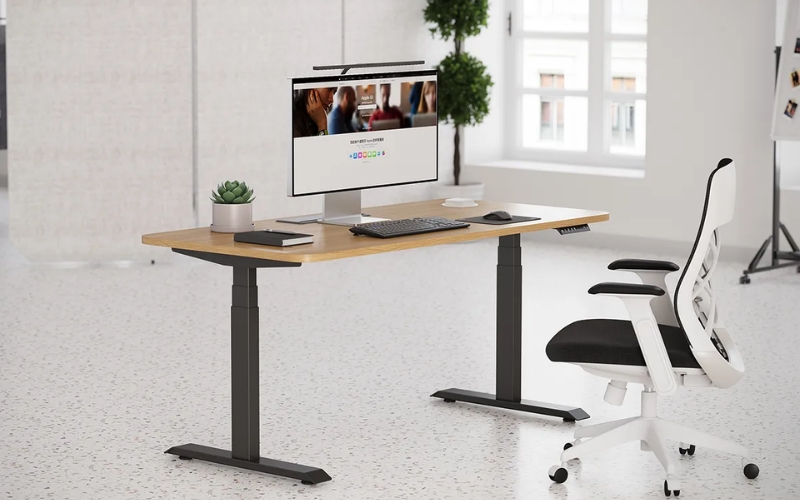
What Is a C-Frame Standing Desk
The name of the C-frame standing desk is derived from the shape of its legs. Viewed from the side, the frame resembles the letter C. The support column is located towards the rear of the foot and not in the middle.
This design eliminates the front crossbar that is still present on some older desks. The result is a safe aesthetic, and additional space to place a desk chair under the desktop. This is a popular style for home offices, as it offers a sense of openness and modernity.
A c frame standing desk can also perform fine in cramped workplaces. Since the foot extends mostly forward, the desk can sit close to a wall. This gives office space in a small flat or apartment that is more useful.
However, a C-frame’s ability to resist tipping is very dependent on the thickness of its steel columns. The lack of that reinforcement makes the frame feel less grounded when subjected to loads. This takes us to the other designs that we should compare.
What Is a T-Frame Standing Desk
A T-frame standing desk places the support column in the exact center of each foot. Viewed from the side, it forms a clear T shape. The foot extends both forward and backward in equal measure.
This symmetric base is the original standing desk design. It has been used in offices for decades because it simply works. The center-placed column keeps the desk balanced no matter how you load it.
Many T-frame standing desk models also include a crossbar between the two legs. That crossbar adds lateral bracing so the desktop resists side-to-side sway. This matters most at maximum height, where legs act like long levers.
A T-frame standing desk shines when the setup includes heavy gear. Think dual monitors on arms, a full tower computer, or a drafting tablet pushed toward the front edge. The centered load path keeps stress even across both legs.
Standing Desk Frame Comparison
| Feature | C Frame Standing Desk | T Frame Standing Desk |
| Leg Shape | Offset column toward rear | Centered column under desktop |
| Knee Clearance | More open space at the front | Slightly less due to front foot |
| Wall Fit | Sits flush against walls | Needs clearance behind rear foot |
| Stability At Extreme Width | Depends on steel thickness | Naturally balanced load path |
| Heavy Equipment Support | Good with reinforced columns | Excellent for front-loaded gear |
| Assembly | Slightly more involved | Straightforward and quick |
| Best For | Small rooms, minimal setups | Multi-monitor and daily heavy use |
This table shows both frames can serve an office well. Still, the choice usually comes down to how you actually use your desk every day.
Stability Compared Between Both Frame Types
The most important factor that people consider when they are looking for c frame vs t frame standing desk options is stability. No one wants a shaky monitor during a video call or a wobbly surface while typing quickly.
Where T Frame Wins On Stability
The T frame standing desk position has the center of gravity over the broadest base of the desk. This provides very good resistance to wobble both forwards and backwards. Centred columns are known to have lower rotational stress in the joints, according to independent engineering reviews.
A t-frame standing desk is more stable for deep desktops that are more than 30″ tall. The crossbar provides extra stability, preventing excessive side-to-side movement even when fully extended. When you lean on the desk or type with extreme vigour, that steady feel is important.
Where C Frame Needs Extra Engineering
A C-frame standing desk pushes all the support work onto the column itself. Without a crossbar, the frame depends on thicker steel and precise tolerances. Cheaper C-frame builds can flex more under uneven loads.
Quality C-frame desks compensate well with reinforced columns. Still, the physics favor a T-frame standing desk when your equipment sits toward the front edge or when the desktop runs wide.
Legroom And Space Compared
Legroom is where a C-frame standing desk usually pulls ahead. The open front lets a chair roll further under the desk. That works nicely for shallow desktops in tight home offices.
A T-frame standing desk needs a bit more clearance because the front foot sits directly under your knees. In return, you gain that steadier, centered support system described above. Most users find the space trade-off minor compared to the comfort gain during long work sessions.
Price And Long Term Value
There is typically little difference in cost between the two types of frames. It’s the long-term value that counts. A properly constructed T-frame standing desk rarely develops wobbling over the years caused by settling.
The Liftdesk standing desk models are designed with two motor systems and reinforced three-stage legs. This maintains affordable prices and stability that can last for many years of daily use and sitting and/or standing.
Adjustable Standing Desk Frame Features To Look For
Regardless of the type of frame you prefer, make sure you look for these features before purchasing an adjustable standing desk frame.
- Easy motor lift for smoother and quieter changes in height.
- Presets memory functions allowing you to save your ideal sitting and standing heights.
- A durable, anti-collision sensor to keep your equipment safe during adjustment.
- Wide height range to accommodate users of all heights
- 3480N solid bearing capacity for practical use in the office.
- A neat cable management system that is integrated in the frame to keep the desk organized.
All these features are applicable to both C-frame and T-frame standing desk builds. However, they tend to be most prevalent in higher quality T-frame equipment that is used on a daily basis in business applications.
If you want more information on standing desks, check Best Standing Desk Frame (2026 Buyer’s Guide)
How Frame Choice Affects Your Daily Ergonomics

The right adjustable standing desk frame is more than just a desk to stand on. It assists in maintaining proper posture all day long. A shaky frame requires minute muscle movements which become fatiguing by afternoon.
An adjustable T-frame standing desk allows one to alternate sitting and standing without hesitation. The height feature will be used more frequently when the desk is stable at all heights. This habit helps circulate more effectively and reduces strain on the lower back over time.
The location of the monitors is also determined by the stability of the frames. The health guidelines recommend that the screen be level or slightly lower than eye level.
If one’s desk is wobbly, fine adjustments of the screen are difficult, particularly if monitor arms are placed near the front edge of the screen. A T-frame standing desk maintains that position between repeated changes.
Office Setups Where Each Frame Fits Best
Different workspaces require different types of frames, so this pairing makes sense.
Here are some situations and the frame that’s better used in each of those situations.
- Home office setup with one monitor and laptop computer. Either frame works well here since loads stay light.
- A group of people is setting up cameras and lights in a studio, with multiple screens visible in the background. The T-frame standing desk does this unevenly, without flex.
- A small room space for an office, against a wall. A C-frame standing desk is compact and will fit well in narrow spaces.
- Multiple employees using the same desk on a regular basis. A T-frame standing desk is more durable when used in a cycling fashion.
- Executive office with a wide desktop over 1600mm. The surface level is maintained from edge to edge with a T-frame standing desk.
If you write your daily routine on a piece of paper, the C-frame vs. the T-frame standing desk decision is a lot simpler. When buyers compare real applications, they are more likely to select the frame designed for consistency than for appearance.
Which Is Best: C Frame Or T Frame Standing Desk

After weighing stability, legroom, and long-term durability, the T-frame standing desk comes out ahead for most buyers.
It handles heavier gear with less stress on the frame. It stays steady at wider desktop sizes. It also tends to hold its stability over years of regular use.
If you run multiple monitors, a full tower PC, or simply want a desk that never feels shaky, choose a T-frame standing desk. This is exactly where the Sendi Standing Desk Frame A from Liftdesk fits in.
The Sendi Standing Desk Frame A is a dual-motor T-frame standing desk built on a three-stage structure. It supports desktops from 1200mm up to 1800mm wide without wobble, even at maximum height. The frame lifts with 1250N of capacity and moves at 40mm per second, among the faster speeds in its class.
You can view full specs and configure your own Sendi Standing Desk Frame A directly on Liftdesk. For buyers who want proven stability in a T-frame standing desk, this model checks every box discussed in this guide.
Explore more Liftdesk standing desk frame options to compare sizes, colors, and desktop finishes for your space.
Final Thoughts
Both styles of frames have made their way into the modern office. For those who prefer an open workspace and close wall fit, a c-frame standing desk is ideal. A T-frame standing desk works for anyone who prefers a desk that is known to be stable with daily use.
Overall, T-frame standing desks are the better choice for many offices and households, thanks to their stability, load capacity, and enduring value. When combined with a sturdy model such as the Sendi Sit to Stand Desk Frame A, this will provide you with a work surface that will remain reliable for many years.
Ready To Upgrade Your Office Furniture?
Stop by Liftdesk today to discover the Sendi Standing Desk Frame, or call them today to create a solid workspace all day long.
FAQs
Q: Is a T-frame standing desk more stable than a C-frame?
Yes, in most cases. A T frame standing desk has the load at the center of the base to improve the stability at the standing position. This is particularly important for wide desktops or thick arms.
Q: Is a C-frame standing desk space efficient?
A C-frame standing desk typically provides more clearance and is able to be positioned closer to a wall. It is suitable for use in small spaces where floor space is more important than load capacity.
Q: Which of the two frames is simpler to put together?
A T-frame standing desk is usually easier to put together, as the pieces are laid out in a symmetrical pattern. Users usually complete the setup within 30 minutes, with the help of the included instructions.
Q: Can a T-frame standing desk support dual monitors?
Yes. A great T-frame standing desk frame such as the Sendi Standing Desk Frame A has dual monitor arms, desktop pc and is totally stable for daily standing without any issues.
Q: What size desktop works best with a T frame?
A Tframe standing desk is suitable for desktops that are 1200mm wide to 1800mm wide. The centered column and crossbar bracing work best with wider desktops.
Q: Is the Sendi Standing Desk Frame good for a home office?
Yes. The adjustable width and quiet dual motor operating system make it suitable for home and commercial offices, while its cable management system ensures reliable operation.